
Franziska Pietsch
Violine


"There are moments
when something happens
between a work of art
and a human being
that can neither be created
nor explained.
Such moments cannot be forced."
As a soloist and chamber musician, Franziska Pietsch performs in concert halls throughout Europe, Asia, and North and South America. Her artistic collaborations include distinguished orchestras and internationally renowned musicians. Her recordings bear the unmistakable imprint of a highly individual artistic voice and have received numerous international distinctions. Among them are the International Classical Music Award (ICMA) and the German Record Critics’ Award for her recording of Sergei Prokofiev’s violin concertos with the Deutsches Symphonie-Orchester Berlin under the direction of Christian Măcelaru.
Recognized at an early age as an exceptional musical talent, Franziska Pietsch made her debut at the Komische Oper Berlin at the age of eleven. She studied with Werner Scholz at the Hochschule für Musik Hanns Eisler Berlin. After winning First Prize at the International Johann Sebastian Bach Competition in Leipzig, her path towards the great concert stages seemed assured.


Then her father’s escape from East Germany fundamentally altered the course of the family’s life. When her mother applied for permission to leave the country, the family entered a period of more than two years of state repression before they were finally allowed to depart for the West. For the young violinist in particular—until then nurtured as one of the GDR’s most promising musical talents—the rupture was profound. From one day to the next, she lost her place within the system.
What followed was far more than the abrupt interruption of an extraordinary musical development. It was an attempt to deprive a young artist of her voice.
And yet it was precisely within this enforced silence that a question emerged—one that has accompanied her throughout her artistic life. She came to understand that great works outlive their creators and remain alive through those who carry them forward in their own artistic voice.
Her encounter with Ulf Hölscher became a defining influence on this path. Further decisive impulses followed at the Juilliard School in New York, where she studied with Dorothy DeLay.
To approach a great work is always, in some way, to encounter oneself.
From this understanding, her artistic path unfolded. Whether as a soloist, chamber musician, concertmaster, or in the rediscovery of rarely performed works, the underlying question remains the same: How can a work become truly alive today?
This path continues to lead Franziska Pietsch to major concert stages as well as into the intimate world of chamber music. It has brought her together with conductors such as Christian Măcelaru, Antoni Wit, and Horst Stein, and taken her to venues including the Berlin Philharmonie, the Elbphilharmonie Hamburg, the Palais des Beaux-Arts in Brussels, the Fundación Juan March in Madrid, and international chamber music festivals.


In chamber music, this artistic journey finds perhaps its most concentrated expression. With the Trio Testore, Franziska Pietsch recorded the complete Brahms piano trios and founded the festival Mai Klassik. With Trio Lirico, she has developed a musical partnership whose shared artistic language has become central to her chamber music work. Numerous recordings—many of them internationally acclaimed and nominated for major awards—document this continuing journey.
Many of her recordings are shaped around carefully conceived programmes in which apparent opposites encounter one another. The familiar and the unknown, established repertoire and works awaiting rediscovery enter into musical dialogue, opening new perspectives on the music itself. Among these projects are the world-premiere recording of Spanish piano quartets by Bartolomé Pérez Casas and Vicente Zurrón with pianist Josu de Solaun and Trio Lirico, as well as Richard Strauss’s Violin Concerto with the Orquesta Ciudad de Granada.
It was from this artistic philosophy that Franziska Pietsch developed musikMachtPoesie, her own distinctive form of concert dramaturgy. Together with an actor, she brings music and language into dialogue, creating programmes that draw audiences deeply into the inner worlds of composers and into the circumstances, thoughts, and emotions from which their works emerged.
Franziska Pietsch is also a regular guest and conversation partner on cultural and music programmes.
At the heart of these conversations are the existential power of music, its relationship with literature, and the question of how art can touch human beings across time and generations. Her poetry springs from the same source, finding literary expression in her volume of poems, Seelenlandschaften.

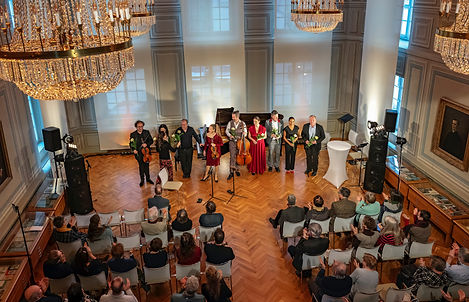
With WINTERKLASSIK, Franziska Pietsch has brought to life a long-held artistic vision: to create a place in which genuine and vital encounters with music, language, literature, and culture can become possible.
The freedom to shape programmes independently of external constraints creates space for uncompromising artistic exploration and for an immediate exchange between artists and audiences.
In this way, WINTERKLASSIK becomes more than a festival. It becomes a space in which those rare encounters can take place that have shaped Franziska Pietsch’s artistic journey from the very beginning—encounters that cannot be manufactured, cannot be commanded, and perhaps cannot ever be fully explained.